Ask which Italian marble is best and you will usually be told all of them are exquisite. That is not an answer. The better question is which one is right for a particular job, at a particular budget, in a particular quantity — and that has a real answer that changes depending on what you are building.
We buy these stones as raw blocks and have done since the 1980s. What follows is how they actually differ, roughly what they cost relative to one another, and — the part nobody writes down — when each is the wrong choice.
The short version
If you want the honest ranking rather than the diplomatic one:
- Best all-rounder: Bianco Carrara. Available in quantity, consistent, affordable.
- Finest: Statuario. Also the hardest to get and the easiest to over-specify.
- Most recognisable: Calacatta. Bought for its veining, so it must be bought as a block.
- Most dramatic: Calacatta Viola or Arabescato, depending on whether you want colour or movement.
- Most underrated: Bardiglio. Grey, calm, plentiful, and cheaper than any of the whites.
- Best value: Botticino and the warm beiges, if your scheme is not committed to white.
1. Bianco Carrara — the workhorse
The stone most people picture when they hear the word marble. A cool white to soft pearl-grey ground with fine, dense, evenly distributed grey veining. It comes from the Carrara basins in the Apuan Alps and it is the backbone of the Italian trade.
That evenness is the commercial point. It repeats across a large floor or a facade without the eye catching on any single slab, which is exactly what you need when a project is measured in hundreds of square metres.
When it is wrong: when you want the stone to be the feature. Bianco Carrara is a background. If a client is paying for drama, they will find it quiet.
2. Statuario — the finest, and the most over-specified
A genuinely brilliant white ground, warmer and more luminous than Bianco Carrara, crossed by sparse, confident grey to charcoal veins. It comes from a small number of upper Carrara quarries. Michelangelo chose it, and the reputation is not marketing.
When it is wrong: almost any large-area application. Yield per block is lower, matched quantities are hard to guarantee, and price moves with what the quarries release. Specifying Statuario for a 600 m² floor is the most common expensive mistake in this trade. Use it where it will be looked at closely.
3. Calacatta — bought for the veining
Warmer than Statuario — ivory rather than pure white — with thick, deliberate veining that often carries gold and taupe alongside the grey. It is the stone that made Italian marble a luxury category.
The named selections — Oro, Borghini — are commercial rather than geological, and different sellers apply them differently. Judge the material from photographs of the actual block, not the label.
When it is wrong: when you are buying slab by slab. No two blocks read the same. If the pattern matters — bookmatching, a continuous wall — you have to buy the block, because slabs bought separately will not sequence however similar they look in a yard.
4. Calacatta Viola — the one people are searching for
A deep purple-to-burgundy veining on a white ground, and currently the most fashionable Italian marble in the world. Demand has outrun what the quarries release, which shows in the price.
When it is wrong: anywhere you need to match it later. It is scarce and highly variable. Buy everything the project needs in one go or do not start.
5. Arabescato — movement rather than lines
Broad grey veins that loop and interlock across a white or pale grey ground, forming closed shapes rather than parallel lines. Where Calacatta is dramatic in a linear way, Arabescato is dramatic in a swirling one.
The commercial name usually carries the source with it — Corchia, Vagli, Cervaiole — and the character differs noticeably between them, so the qualifier belongs in your specification.
When it is wrong: if your cutting plan is fixed. The pattern is strongly directional, and sawing orientation changes the result substantially.
6. Bardiglio — the underrated grey
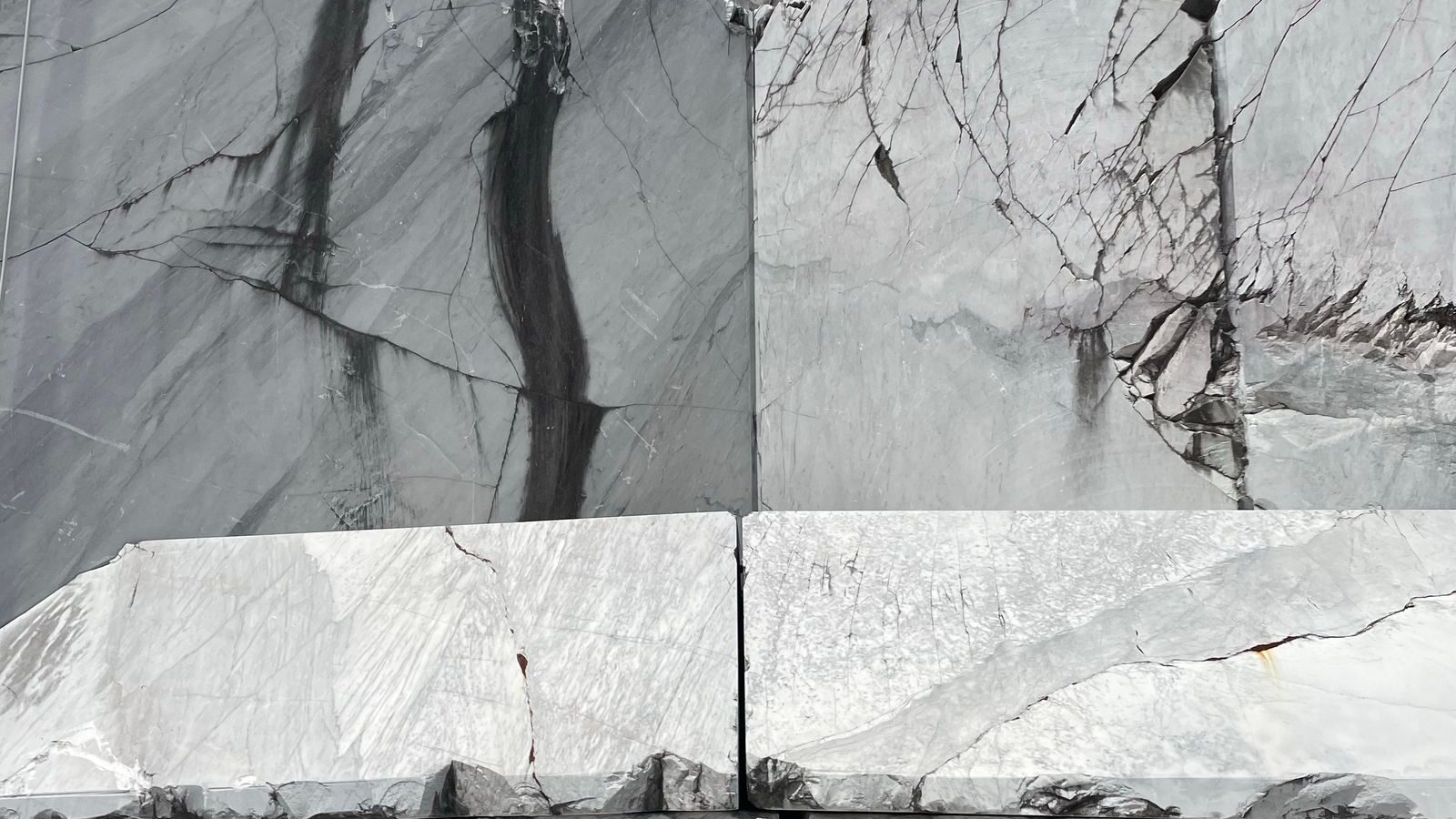
From the same basins as the Carrara whites, running from soft dove grey to a deep, almost blue charcoal, with fine darker veining. In the Nuvolato selections it takes on a clouded, smoky character.
It pairs naturally with Bianco Carrara — a combination Italian architects have used for centuries — and it holds a floor together without competing for attention. Availability is good and pricing is stable.
When it is wrong: in dark rooms. It is a grey stone and it will read as heavy without good light.
7. Botticino, Giallo Siena and the warm marbles
Not every project wants a white marble. Botticino is close to uniform and behaves well over large areas. Giallo Siena is strongly brecciated, with dark veining fracturing a gold ground, and works better as an accent than as a field. The soft beiges sold under various Crema names sit between them.
When it is wrong: when you need predictability. These come from different regions and different quarries, so availability and pricing are less reliable than for the Carrara whites.
What is the most expensive Italian marble?
Top-grade Statuario, followed by Calacatta Viola when supply is tight. But “most expensive” is a moving target: price follows what the quarries release, and a spectacular Calacatta block can outprice an ordinary Statuario one. Grade within a variety matters more than the variety name.
Choosing, in one paragraph
Work backwards from area and from how closely the stone will be seen. Large areas and long sight-lines want consistency, which means Bianco Carrara or Bardiglio. Small areas that people stand next to want character, which is where Statuario, Calacatta and Arabescato earn their price. If the scheme is warm rather than cool, the beiges will do the job for less. And if the pattern matters at all, buy the block rather than the slabs.
Common questions
What is the best Italian marble?
For most projects, Bianco Carrara — it is consistent, available in quantity and affordable. Statuario is the finest material but is scarce and better suited to small, closely viewed areas than to large floors.
What is the difference between Carrara and Calacatta?
Carrara has a cooler, greyer ground with fine even veining. Calacatta is warmer, closer to ivory, with thicker and more dramatic veining that often carries gold. Calacatta is rarer and costs considerably more. There is a fuller comparison in our guide to Carrara, Calacatta and Statuario.
Is Italian marble better than marble from elsewhere?
Not automatically. Italy has an unusual concentration of high-quality white marble and centuries of extraction and selection expertise, which is why the famous names are Italian. But Greek, Turkish and Spanish quarries all produce excellent stone, and a good block from one of those will beat a poor Italian one.
How many types of Italian marble are there?
Dozens of commercial names, but they resolve into a much smaller number of families: the Carrara whites, the greys, the warm yellows and beiges, and a handful of distinctive coloured stones. Commercial names are marketing conventions rather than geological classifications, and different sellers use them differently.