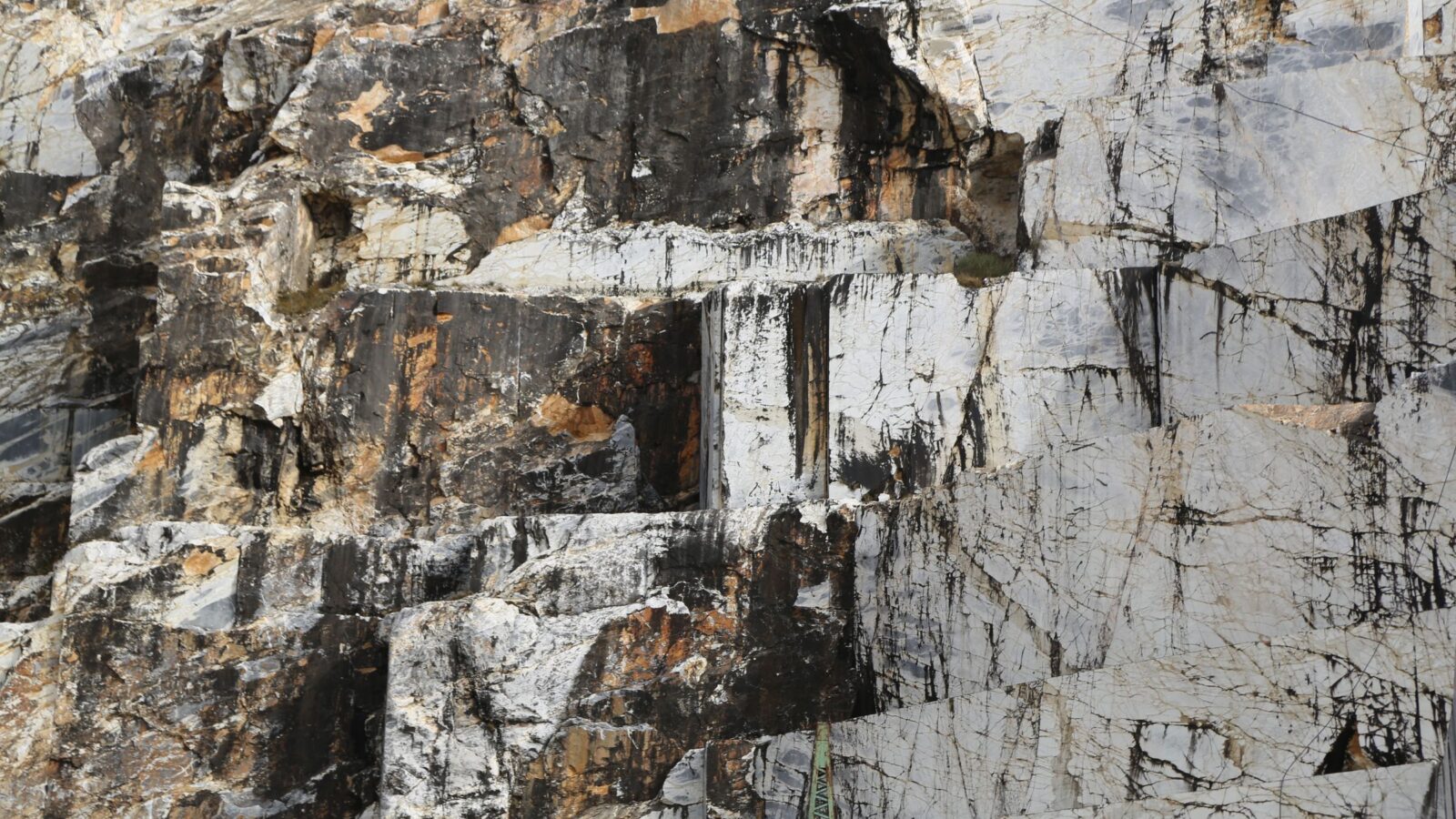
Marble is limestone that has been buried, heated and squeezed until it changed into something else. Everything about how it looks, what it costs and where you can get it follows from that one fact.
How is marble formed?
It begins as limestone — the compacted remains of shells and marine organisms on an ancient seabed. When tectonic movement buries that limestone and subjects it to high pressure and temperature, the calcium carbonate recrystallises. The fine muddy grains of limestone grow into interlocking calcite crystals. That process is metamorphism, and the result is marble.
This is why marble is classed as a metamorphic rock rather than a sedimentary one, and why it takes a polish that limestone cannot. The crystals are larger and locked together, so the surface can be cut and burnished to reflect light.
The veining is the impurities. Pure calcium carbonate metamorphoses into white marble; clay, silt, iron oxides and organic matter caught up in the original limestone become the grey, gold, green and purple veins. A stone with almost no veining, like top-grade Statuario, formed from an unusually pure limestone.
Where is marble found?
Wherever limestone met heat and pressure — which is to say, in mountain ranges. There is marble in Greece, Turkey, Spain, Portugal, India, China, Brazil and the United States, and some of it is excellent.
What makes the Apuan Alps in Tuscany unusual is not that marble exists there, but the combination: an exceptionally pure limestone protolith, a mountain range that has lifted the deposit close to the surface, and two thousand years of accumulated knowledge about which seams yield what. The Romans were quarrying here before the Empire.
The Carrara basins
What is loosely called “Carrara marble” comes from three main basins above the town — Torano, Fantiscritti and Colonnata — subdivided into a large number of individual quarries. Different quarries within a few kilometres of one another produce materially different stone.
This is why quarry provenance matters more than the commercial name. Statuario comes from a small number of specific upper quarries; the various Arabescato selections carry their quarry in the name — Corchia, Vagli, Cervaiole — because the character genuinely differs. A supplier who can tell you the quarry is telling you they were there.
From the mountain to a block
Modern extraction bears no relation to the hammer-and-wedge image. The sequence runs roughly like this:
- Reading the face. Before anything is cut, the working face is assessed for fracture patterns, glass veins and iron staining. Cutting in the wrong place wastes months.
- Diamond wire sawing. A loop of steel cable strung with diamond beads is drawn through the rock under tension, cooled with water. It cuts slowly and cleanly, and it is what makes those flat quarry walls.
- Freeing the bench. A large mass — hundreds of tonnes — is cut free and tipped onto a prepared bed of debris that absorbs the fall without shattering it.
- Squaring. The bench is cut down into marketable blocks, typically around 280–330 cm long by 150–190 cm in the other two dimensions, which is roughly 6–10 cubic metres, or 18–27 tonnes.
- Selection and grading. Blocks are assessed for background colour, veining regularity, cracks and squareness, then priced against a commercial grade.
Only after that does a block become tradeable. Everything before this point is why two blocks of nominally the same stone can differ so much in price.
From block to slab
Blocks go to a sawmill and are cut on a gangsaw or a multi-wire machine — dozens of parallel diamond wires drawn through the block at once — into slabs, most commonly 2 cm or 3 cm thick. A 20-tonne block yields a set of slabs that are sequential: slab one follows slab two, and the veining continues across them.
That sequence is the whole reason to buy a block rather than slabs. It is what makes bookmatching possible, and it cannot be reconstructed afterwards by buying similar-looking slabs from a yard.
Slabs are then resined if needed, polished or honed, photographed, numbered and sold as bundles. From there they go to fabricators who cut them to the shapes a project actually needs.
Why any of this matters to a buyer
Because every step is a place where the material can be improved or degraded, and where somebody makes a judgement on your behalf. The person who chose where to cut the face, the person who graded the block, the person who decided which way to orient it on the saw — each of them changed what you eventually receive.
That is the argument for buying from someone who was actually at the quarry rather than from a catalogue. Not because the stone is different, but because the judgement is.
Common questions
Where does marble come from?
From metamorphosed limestone, quarried in mountain ranges around the world. The best-known white marbles come from the Apuan Alps around Carrara in Tuscany, but Greece, Turkey, Spain, India and Brazil all produce significant quantities.
How is marble formed?
Limestone is buried under heat and pressure until its calcium carbonate recrystallises into interlocking calcite crystals. Impurities in the original limestone — clay, iron, organic matter — become the veining.
What is marble made of?
Predominantly calcite, a crystalline form of calcium carbonate, with mineral impurities producing the colour and veining.
Is marble still quarried in Carrara today?
Yes. The Apuan basins have been worked continuously since Roman times and remain in active production, using diamond wire sawing rather than the hand methods of earlier centuries.
How big is a marble block?
A standard marketable block is roughly 280–330 cm long and 150–190 cm in height and depth — about 6–10 cubic metres, or 18–27 tonnes. A European truck carries 24–25 tonnes; a 20-foot container is limited by weight at roughly 26–28 tonnes.