Every marble supplier answers this with “contact us for pricing”. That is understandable — the honest answer has a lot of variables in it — but it is not useful when you are trying to work out whether a scheme is affordable before you commit to it.
So here is the honest answer, with the variables named. We will not quote you a number for your project on a web page, because anyone who does is guessing. But you should be able to leave this page knowing roughly what range you are in and what will move you within it.
What actually drives the price
In rough order of impact:
- Variety. The gap between ordinary Bianco Carrara and top-grade Statuario is roughly a factor of ten, sometimes more.
- Grade within the variety. Frequently a bigger swing than the variety name. A first-choice Carrara block can cost several times a commercial one.
- Block size and squareness. Larger, well-squared, saw-ready blocks command a premium because they yield more usable slab area.
- Form. Raw blocks, sawn slabs and finished pieces are three different markets. Each processing step adds cost and margin.
- Quantity. Freight per tonne falls sharply once a truck or container is full.
- Timing. Prices follow what the quarries release. Scarce varieties move noticeably year to year.
Relative pricing, which is the useful part
Absolute prices date quickly and vary by grade, quantity and the week you ask. Relative pricing is far more stable, and it is what you actually need for a feasibility sketch. Taking ordinary Bianco Carrara as the baseline:
- Bardiglio and the warm beiges — at or slightly below Bianco Carrara.
- Bianco Carrara — the baseline. The reference price of the Italian trade.
- Arabescato — commonly two to four times the baseline, depending on selection.
- Calacatta — commonly four to eight times, and higher for the named selections.
- Statuario — commonly six to twelve times for good grades, and open-ended at the top.
- Calacatta Viola — currently priced by fashion as much as by geology. Treat quotes as valid only briefly.
These are trade-wide observations, not our price list. Your actual number depends on grade, volume and where it has to go.
Blocks versus slabs
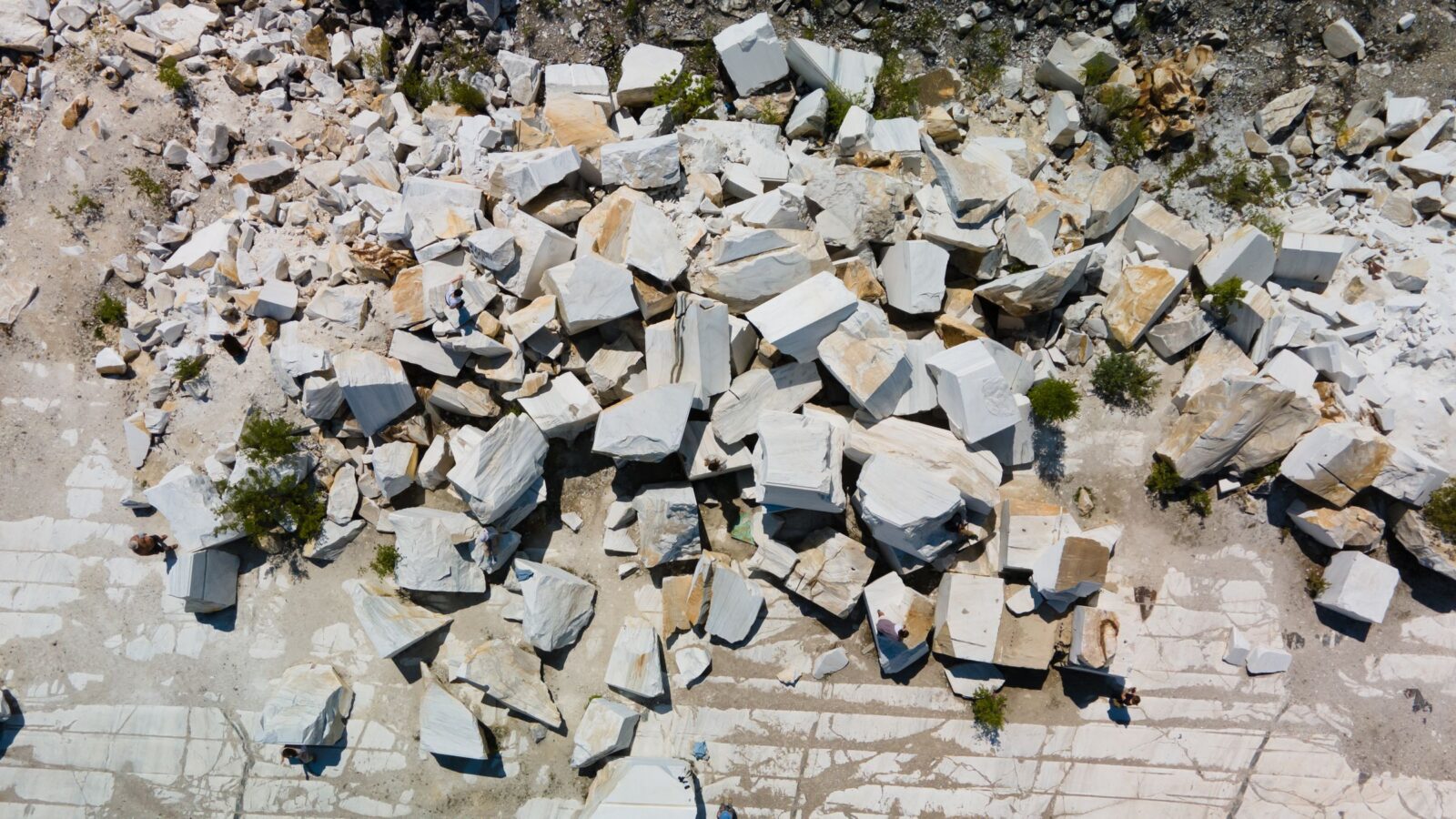
A raw block is the cheapest way to buy marble per tonne and the most expensive way to get it wrong. You are buying a volume of stone whose interior nobody has seen, on the strength of the quarry, the grade and the judgement of whoever selected it.
Buying slabs costs more per square metre but removes that risk: you can see exactly what you are getting. The trade-off is that you give up the sequencing. Slabs cut from one block follow each other; slabs bought separately never will.
Rule of thumb: buy blocks if you saw your own material or the pattern matters. Buy slabs if you need certainty and the quantity is modest.
What freight adds
Marble is heavy, and freight is frequently the difference between a competitive offer and a pointless one. A European truck carries 24–25 tonnes; a 20-foot container is limited by weight rather than volume at roughly 26–28 tonnes of stone.
Because those limits are fixed, the freight cost per tonne falls sharply as the load fills and then stops falling. Half a truck costs nearly what a full truck costs. If you are close to a full load, round up.
Always compare landed prices rather than ex-works prices. An attractive quote from a distant supplier stops being attractive once the sea freight is added, and the only way to see that is to insist both quotes are on the same basis.
What is the most expensive marble in the world?
Top-grade Statuario is the usual answer, with exceptional Calacatta blocks and Calacatta Viola competing when supply tightens. But the honest version is that a single spectacular block of a mid-priced variety can outprice a mediocre block of the most prestigious one. Grade travels further than the name.
How to get a number you can rely on
Send four things and any competent supplier can price it properly: the variety and grade you want, the tonnage or square metres, the maximum block size your saw takes if you are buying blocks, and the destination — port for containers, full address for European truck delivery.
What comes back should be a landed price against a named grade, with photographs of the actual material. Anything vaguer than that is not a quote, it is an opening position.
Common questions
How much does Italian marble cost per square metre?
It depends far more on variety and grade than on anything else — the range across Italian marbles spans more than a factor of ten. Ordinary Bianco Carrara sits at the bottom, top-grade Statuario at the top. Ask for a landed price against a named grade rather than a per-square-metre figure in isolation.
Is Italian marble expensive?
Some of it is among the most expensive stone in the world; some of it is cheaper than good porcelain. Bianco Carrara is an economical material available in large quantities. Statuario and Calacatta are luxury goods priced by scarcity.
Why are marble prices quoted per tonne rather than per square metre?
Raw blocks are traded by weight or by cubic metre because their yield in slab area is not known until they are sawn. Slabs are quoted by area because that is what you are buying.
Does buying direct from Italy save money?
It removes a layer of margin, which is real. But it adds freight, customs handling and the risk of buying material you have not inspected. It pays when the quantity is large enough to fill a truck or container and when your supplier photographs and measures the actual blocks before loading.