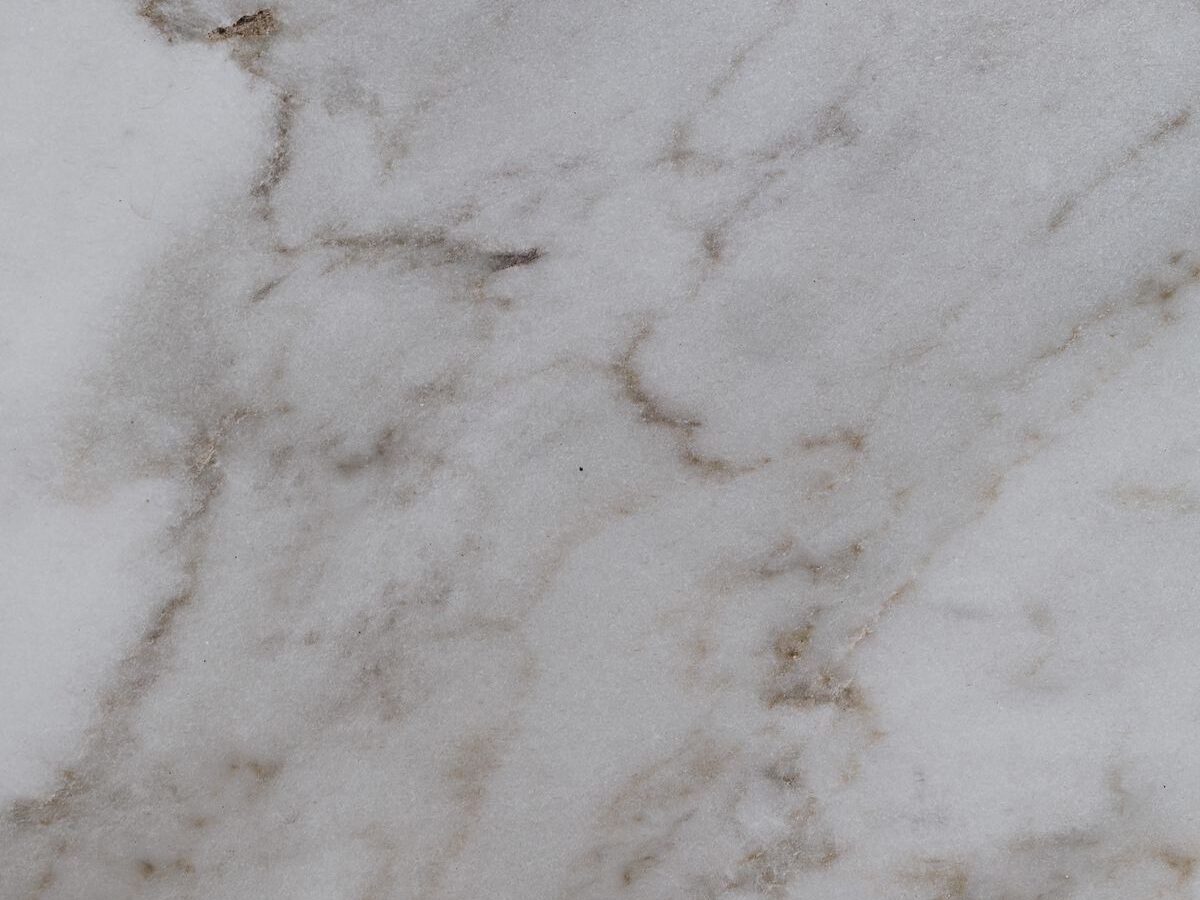
These three come out of the same range of mountains, they are all white, and they differ in price by a factor of ten. That combination makes them the most confused — and most misrepresented — stones in the trade.
Here is how to tell them apart by eye, and what to check before you accept that a slab is what the invoice says it is.
The quick comparison
- Bianco Carrara — cool, greyish white ground. Fine, dense, even veining. Widely available. The cheapest of the three by a wide margin.
- Calacatta — warm, ivory ground. Thick, bold, well-separated veins, often with gold or taupe. Scarce. Several times the price of Carrara.
- Statuario — brilliant, luminous white ground. Sparse, sharp, confident grey to charcoal veins. Scarcest of the three. The most expensive.
Tell them apart by the background, not the veins
Most people try to identify these stones by their veining. That is the harder way round, because veining varies enormously within a single variety — even within a single block.
Look at the ground instead. Bianco Carrara has a distinctly grey cast; put it beside the other two and it reads almost dirty. Calacatta is warm and creamy, tending to ivory. Statuario is the brightest and cleanest white of the three, with a faint warmth that stops it looking clinical.
Once you have placed the background, the veining confirms it. Carrara veining is fine and busy and covers the whole surface. Calacatta veining is thick and deliberate with clear white space between the veins. Statuario veining is sparse and sharply drawn, like ink strokes rather than a wash.
Why the price gap is so large
All three are quarried in the Apuan Alps, often within a few kilometres of each other. The difference is how much of it there is.
Bianco Carrara comes out of many quarries in large volumes. Calacatta and Statuario come from a small number of specific quarries, and within those, only certain seams produce material that qualifies. Yield per block is lower too, because the selection standard is stricter. Scarcity does the rest.
This is also why the price of Statuario moves noticeably from year to year while Bianco Carrara stays relatively stable. If your project needs Statuario, the binding constraint is usually availability rather than budget.
How suppliers blur the line
Because the names carry the price, they get stretched. Some things worth knowing:
- “Calacatta” is not a protected term. It is a commercial name, applied loosely, and stones from outside Italy are sold under it.
- Carrara Venatino gets sold as Statuario. Venatino is a lighter, more strongly veined Bianco Carrara selection. It is a fine stone and it is not Statuario.
- “Calcutta” is a misspelling of Calacatta, not a different stone. If it appears in formal documentation, that tells you something about the seller.
- Grade is often omitted. “Statuario” without a stated grade could be anything from Extra to commercial, and the price difference between them is substantial.
What to ask before you accept a delivery
Three questions settle most disputes before they start. Which quarry did the material come from? What grade is it, in the seller’s own words? And can you see photographs of the actual block or slab bundle, not a stock photograph of the variety?
A supplier who can answer all three quickly is telling you they selected the material themselves. One who cannot is reselling something they have not seen.
Which should you specify?
For large floors, cladding and anything where consistency across many square metres matters: Bianco Carrara. For a kitchen island, a feature wall or a bookmatched panel where the stone is the point: Calacatta. For sculpture, small high-value areas and work that will be examined at arm’s length: Statuario, bought early because availability constrains it.
And whichever you choose, if the pattern matters, buy the block. Slabs cut from one block sequence together. Slabs bought separately do not.
Common questions
Is Calacatta better than Carrara?
It is rarer and more expensive, but not better for every job. Calacatta is bought for dramatic veining on a warm ground. If you need consistency across a large area, Bianco Carrara will perform better and cost far less.
Is Statuario the same as Carrara?
Statuario comes from the Carrara area, so it is a Carrara marble geographically, but it is a distinct and much rarer selection. Ordinary Bianco Carrara has a greyer ground and finer, denser veining.
What is Calcutta marble?
A common misspelling of Calacatta. There is no separate stone called Calcutta marble.
How can I tell if marble is really Italian?
Ask for the quarry name and the certificate of origin, and look at photographs of the actual material. Commercial names travel; quarry names and shipping documents do not.